Introduction
Cosmetic ear surgery is a surgery to change the shape, position or size of the ears.
This surgery may be used in a number of situations. For example, some people choose to have Cosmetic ear surgery because they are bothered by how far their ears stick out. Others might get this surgery if one or both ears have changed shape due to an injury.
Cosmetic ear surgery also may be used if the ears are a different shape because of a birth defect.
Historical background
Surgical correction of ear deformities has been reported in the literature as far back as 1845. In the majority of cases, this finding has little relation to other anatomic or physiologic abnormalities. Through the years, hundreds of techniques have been described to correct the auricular deformity. Today, this wide variety of options may hinder the surgeon from choosing the correct procedure best suited for a particular patient. This is why a thorough understanding of ear anatomy is one of the most essential steps in the preoperative management of an Cosmetic ear surgery candidate.
With the surgeon’s objective algorithm toward an auricular deformity, the patient may ultimately enjoy the maximal aesthetic outcome possible for his or her case
Who needs it?
The wide range of patients who would benefit from Cosmetic ear surgery are:
- Children or adolescents who struggle with self-esteem issues, bullying and teasing
- Adults who have years long of poor self-image
- People who avoid social interactions or certain hairstyles due to the visibility of their ears
- Anyone seeking to align their outer appearance with their inner confidence
When is it done?
Once the ears have reached their full size, Cosmetic ear surgery can then be done anytime. Children from 4 to 6 years onwards can get it done. Adults also can get Cosmetic ear surgery.
If a baby is born with prominent ears and certain other ear-shape issues, a different treatment may be an option. It’s called splinting, and it doesn’t involve surgery. Devices called splints are placed on the baby’s outer ear. The splints are adjusted each week for about 4 to 6 weeks. For best results, splinting must be done during the first few days of life. This is when the ear is soft and can be molded. Splinting is not proven to be as effective when it’s done after the first few weeks of life.
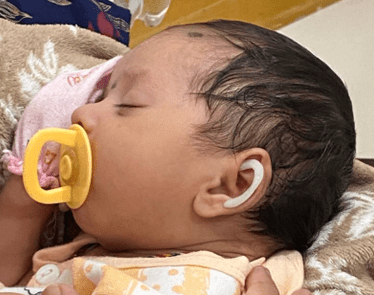
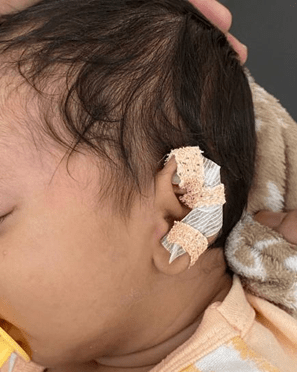
Ear molding/ splinting done for a patient after few weeks of birth to improve ear contour
Why is it done?
You might think about getting Cosmetic ear surgery if:
- Your ear or ears stick out too far from your head.
- Your ears are large compared with your head.
- Unsatisfied results from a past ear surgery.
Usually, Cosmetic ear surgery is done on both ears for a balanced look. This concept of balance is called symmetry.
Cosmetic ear surgery doesn’t change where on your head the ears are located. It also doesn’t change your ability to hear.
Types of Cosmetic Ear Surgery
There are different types of Cosmetic ear surgery, depending on the patient’s needs. Three of the most common are:
- Ear Augmentation. It treats small ears or ears that haven’t fully developed. It typically uses tissue grafting to increase the outer portion of your ear.
- Ear Pinning. In case of ears sticking out quite noticeably, this procedure can bring them closer to the sides of the head.
- Ear Reduction. In this procedure, the surgeon removes tissues to make large ears look smaller.
Non-surgical Techniques
Due to the possible complications of Cosmetic ear surgery, it is important to keep in mind the nonsurgical option when evaluating the prominent ear of an infant. In recent years, splinting has proven to be an alternative option when the prominent ear is detected early after birth.
In these cases, correction within the first 96 hours of birth is the most effective. However, the first few weeks of life may still spare the infant from an operative procedure.
For optimal correction, bone wax is a reliable material which is commonly used to shape and splint the ear. Surgical tape can be used to cover and hold this in place, and should remain in place for 2 weeks.
What to Expect?
Before
Cosmetic ear surgery can be done in a hospital or in a surgical centre like ours where it is quite frequently performed.
It’s usually done under General Anaesthesia where you’ll be given adequate painkillers and antibiotics.
During
Cosmetic ear surgery techniques vary. The technique your surgeon chooses determines where the incisions are made.
There are techniques that make incisions on the backs of your ears or within the inner creases of your ears. Surgeons often choose these areas to help keep Cosmetic ear surgery scars hidden.
After making incisions, your surgeon might remove extra tissue including cartilage and skin. Then the cartilage is folded into the proper position and secured with stitches inside the ear. More stitches are used to close the incisions.
The surgery typically takes about 1-2 hours.
In our centre, we choose the best possible incision design to hide the scar or make it least prominent and/or noticeable.
After
After Cosmetic ear surgery, your ears will be covered in bandages or dressings for protection from infection and support.
Some discomfort and itching is common.
The incisions shouldn’t be rubbed or placed force on.
A few days after Cosmetic ear surgery, your surgery team removes your bandages. Your ears likely will be swollen. You may need to wear a loose headband that covers your ears at night for a few weeks. This helps keep you from pulling your ears forward when rolling over in bed.
Some stitches dissolve on their own. The rest are to be removed by the surgical team in the days to follow after surgery.
Advantage of Cosmetic Ear Surgery
- Boosts self-confidence. Children and teens, even adults, may feel conscious about having quite prominent, disproportionate ears which may end up looking funny. This cosmetic surgery can bring the ears into a more balanced position and enhance the facial appearance.
- Counters bullying/teasing/isolating. Often, our unique features might be a favourite subject of bullying and teasing. This can lead to young people often resorting to some wrong notions of cosmetic surgery. We might see them hiding their ears with hideous forms of hairstyles or head accessories like oversized hats etc. Usually, such people can benefit from cosmetic ear surgery.
- Enhances self-image. Be it someone working in the showbiz or public domain, where appearances and showing up matter a lot; cosmetic ear surgery can further enhance their self-image. People can feel good about themselves and this procedure can further maximize the overall quality of life.
- Gives the space for personal expression. Once are facial features are set the way we want them to be, we can experiment with a lot of personal style, hairstyles, looks, ear accessories etc. Those patients will not feel the need to hide their ears anymore.
- Changed appearance. This surgery makes it further possible for people to finally achieve the appearance they so much desired for. They can confidently step into the world, confident with their brand new look.
- Permanent results. The most beneficial advantage of cosmetic ear surgery is that its results are mostly permanent. So once a patient has undergone the surgery, they can be rest assured of their ear shape and position. Minor changes or corrections can be done in future if need be; but results are more often satisfactory in the first and primary surgery itself.
Risks and Complications of Cosmetic Ear Surgery
As with any surgery, Cosmetic ear surgery has its own fair share of risks.
- Ears that don’t look balanced in placement. It could happen due to changes during the healing process. Also, Cosmetic ear surgery might not fix asymmetry that was present before surgery.
- Changes in feeling. Changing the position of your ears can affect how the sensation over the skin feels. This effect often goes away, but rarely it is lasting.
- Ears look “pinned back” after surgery. This is known as an overcorrection. It’s done as a preventive measure for relapse sometimes. With time, the ears will start to look normal and balanced.
- Auricular hematoma is bleeding around your ear cartilage
- Infected ear cartilage
- Numbness
Results
When your bandages are removed, you’ll see a change in how your ears look. These changes are usually are long lasting.
If you’re not satisfied with your results, asking your surgeon if a second surgery is worth it would help. This is known as a Revision surgery.
Recovery and Outlook
What is the recovery time?
Cosmetic ear surgery recovery can take up to eight weeks. Improvements are visually noticeable in two to three weeks. Healing times may vary for everyone.
What about follow-up appointments?
Your surgeon wants to know if your ears are healing well. The first follow-up is usually 1 week after the surgery. Here, they’ll remove your dressing/bandages.
After that, you need to see your surgeon for one to two more follow-ups over the next few weeks to ensure that healing is in progress and your recovery is on track.
Conclusion
Our centre can confidently say that cosmetic ear surgery is a good way for people who want their ears to be enhanced, corrected or changed in shape. We offer personalised options for all our patients by taking into account their wants and desires.
We can proudly say that so far, all our patients who have undergone cosmetic ear surgery have been highly satisfied with their results.
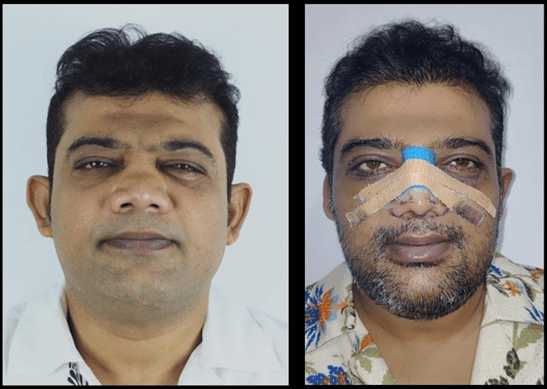
Figure shows bat ear deformity for a patient and 8 days post surgery
He also underwent other surgeries including Rhinoplasty and hence the splint on the face
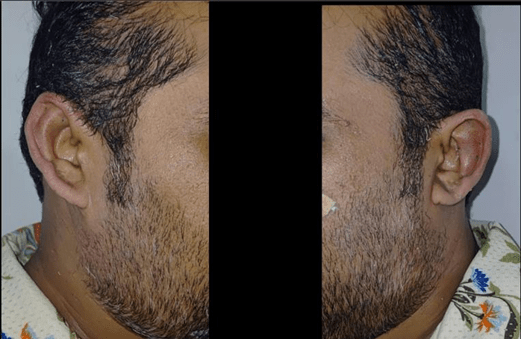
Figure shows the set position of the ears just few days after the surgery